
Estimated Read Time: 8 minutes
When your product demand scales beyond prototype quantities, choosing the right manufacturing method becomes critical to your bottom line. The difference between selecting die cutting versus injection molding or stamping can mean thousands of dollars saved per production run, faster time-to-market, and the ability to maintain tight tolerances across millions of parts.
High-volume manufacturing transforms raw materials into finished components at scale, delivering the consistency your customers expect while keeping your per-unit costs competitive. Understanding which method matches your production needs helps you avoid costly tooling investments in the wrong process and positions your supply chain for reliable, repeatable output.
Here’s what you’ll gain from this guide:
- Die Cutting Precision: How die cutting delivers precision at speed for flexible materials while keeping your tooling costs manageable
- Injection Molding Economics: Why injection molding becomes cost-effective once you cross specific volume thresholds and how cycle times impact your production schedule
- Stamping Operations: When stamping operations can produce hundreds of parts per minute and what material thicknesses work best
- Automation Benefits: How automation reduces your labor costs and increases throughput across all high-volume methods
Request a free quote or call Josh Rodman at (707) 769-4488 to discuss your project specifications.
Die Cutting: Speed and Precision for Flexible Materials
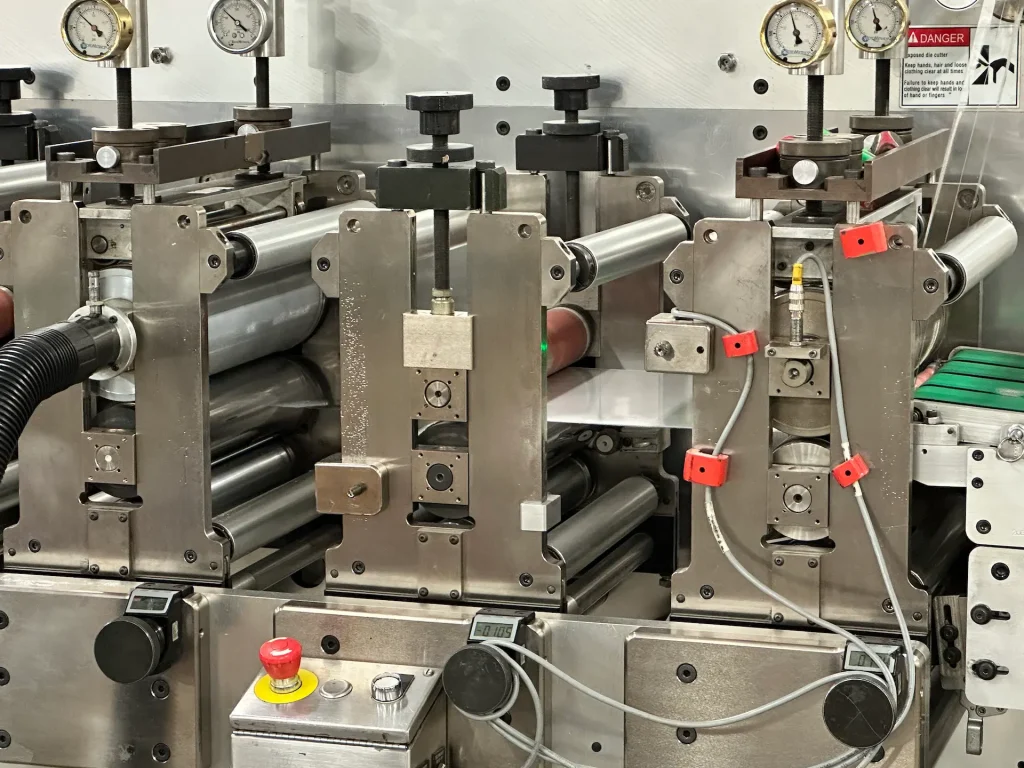
Die cutting transforms sheet materials into precise components by using sharp steel rules or blades pressed through the material. This process excels at producing gaskets, seals, protective films, labels, and custom-shaped parts from flexible substrates, including plastics, foams, adhesives, and thin metals.
Your production benefits from die cutting when you need consistent dimensional accuracy across thousands or millions of parts. Steel rule dies typically achieve tolerances of ±0.005 inches, with some applications reaching ±0.003 inches in critical areas. For aerospace and medical applications requiring even tighter specifications, solid mill dies can hold ±0.001 inches, though at higher tooling costs.
Rotary vs. Flatbed Die Cutting
| Factor | Rotary Die Cutting | Flatbed Die Cutting |
| Best For | High-speed continuous production | Thicker materials and multi-layer assemblies |
| Material Thickness | Thin to medium gauge | 0.1mm to 25mm thick |
| Production Speed | Thousands per cycle | 20 to 1,500 strokes/min |
| Setup | Continuous web feeding | Vertical press with simultaneous pressure |
Your initial tooling investment for die cutting remains significantly lower than alternatives like injection molding. Steel rule dies cost a fraction of injection molds, with development timelines measured in days or weeks rather than months. This makes die cutting economical for medium-volume runs and allows faster iteration if you need design changes.
Die Cutting Tolerance Capabilities
| Die Type | Typical Tolerance | Best Application |
| Steel Rule Dies | ±0.005 inches | Standard industrial parts |
| High-Precision Steel Rule | ±0.003 inches | Critical dimensional requirements |
| Solid Mill Dies | ±0.001 inches | Aerospace and medical components |
Injection Molding: Economies of Scale for Complex Geometries
Injection molding creates plastic parts by melting polymer pellets and injecting the molten material under high pressure into precision molds. The process begins with plastic pellets fed into a heated barrel where temperatures reach 200°C to 300°C, depending on the polymer. An injection screw pushes the molten plastic into a mold cavity under pressures reaching 10,000 to 30,000 psi.
Injection Molding Production Economics
| Production Volume | Cost per Part | Tooling Investment | Lead Time |
| Under 10,000/year | Higher than alternatives | $3,000 to $100,000+ | 8 to 20 weeks |
| 30,000+ parts/year | $0.28 (vs $2.80 thermoforming) | Amortized over volume | 12 to 20 weeks |
| 100,000+ parts/year | Dramatically reduced | Multi-cavity molds | 15 to 20 weeks |
Simple parts with thin walls may complete cycles in 10 to 30 seconds, while complex geometries require 30 to 120 seconds per cycle. Multi-cavity molds amplify your production rate by forming multiple parts simultaneously. A four-cavity mold producing parts in 30 seconds delivers four components in the same time a single-cavity mold produces one, effectively quadrupling output.
What You Gain vs. What You Trade Off
| Advantages | Limitations |
| Design Freedom: Create complex geometries with undercuts, threads, and intricate details impossible with other methods. Injection molding supports hundreds of thermoplastic materials, from the impact resistance of ABS to the high-temperature performance of PEEK. Automated Quality: Real-time sensors monitor material flow, temperature, and pressure, making automatic adjustments to maintain specifications. These automated quality controls catch defects immediately, reducing scrap rates. Minimal Labor: Once tooled and automated, injection molding requires minimal labor per part, dramatically reducing your ongoing production costs. | Upfront Investment: Tooling costs from $3,000 to over $100,000 require volume commitments. Lead Time: Production molds need 8 to 20 weeks, delaying time to market. Design Changes: Mold modifications are expensive once tooling is complete. |
Stamping: High-Speed Production for Sheet Metal Components
Metal stamping transforms flat sheet metal into three-dimensional parts through dies and presses. When you need metal components in volumes exceeding 100,000 parts annually, stamping delivers unmatched production rates.
Metal Stamping Production Specifications
| Stamping Type | Material Thickness | Production Speed | Tolerance |
| Progressive Die | 0.1mm to 10mm | 20 to 1,500 strokes/min | ±0.025mm to ±0.1mm |
| High-Speed Progressive | Thinner gauges | 120 to 300 strokes/min | ±0.025mm to ±0.1mm |
| Transfer Die | 0.5mm to 12mm | Slower than progressive | ±0.025mm to ±0.1mm |
Tooling costs range from $10,000 to $50,000 with lead times of 4 to 8 weeks, making stamping uneconomical below 3,000 units. Progressive die stamping achieves 70% to 85% material utilization, meaning the majority of your sheet metal becomes finished parts rather than scrap. The process maintains tolerances across thousands of cycles, delivering the consistency required for precise assembly.
Automation: Reducing Labor Costs and Increasing Consistency
Automation transforms high-volume manufacturing by eliminating variability and reducing labor requirements. Companies implementing automation report average operating cost reductions of 22%, with some applications delivering 30% to 200% ROI in the first year.
Automation Impact on Manufacturing Performance
| Performance Metric | Improvement Range | Business Impact |
| Operating Cost Reduction | 22% average | Direct bottom-line savings |
| First-Year ROI | 30% to 200% | Fast payback on investment |
| Scrap Rate Reduction | 15% to 25% | Less material waste |
| Inspection Speed | 30 to 60 parts/min | Eliminates bottlenecks |
| Inspection Accuracy | 99% | Far exceeds manual capability |
Real-time monitoring systems track production parameters, including dimensional accuracy, cycle times, and defect rates. Statistical Process Control software analyzes this data, identifying trends before they create scrap.
Vision inspection systems examine every part at high speeds, detecting defects as small as 0.1mm². These systems catch dimensional variations and surface defects with 99% accuracy, far exceeding manual inspection capabilities.
Rather than eliminating jobs, automation shifts workers into higher-value roles. Over 90% of workers report that automation increases their productivity, and 88% report higher job satisfaction after tedious tasks are automated.
Method Selection Guide: Matching Process to Your Production Requirements
| Your Requirement | Best Method | Why It Works |
| Flexible materials (foam, film, adhesive) | Die Cutting | Handles flexible substrates without damage |
| Complex plastic geometries | Injection Molding | Creates intricate features in a single operation |
| Metal parts above 100,000/year | Stamping | Unmatched speed and per-part cost |
| Volumes under 10,000/year | Die Cutting | Lower tooling cost justifies smaller volumes |
| Fastest tooling turnaround | Die Cutting | Days to weeks vs. months |
| Lowest per-part cost at 100,000+ units | Injection Molding or Stamping | Volume amortizes high tooling investment |
Many manufacturers use multiple methods strategically. You might prototype with die cutting to validate designs quickly, then transition to injection molding once volumes justify the tooling investment. Or you might stamp metal housings while die cutting gaskets and seals for the same assembly.
Ready to scale your component production? Understanding which high-volume manufacturing method matches your specific requirements determines whether your supply chain delivers reliable parts at competitive costs.
Request a Free Die Cutting Quote or call Josh Rodman directly at (707) 769-4488 to discuss your material specifications, volume projections, and timeline requirements.