
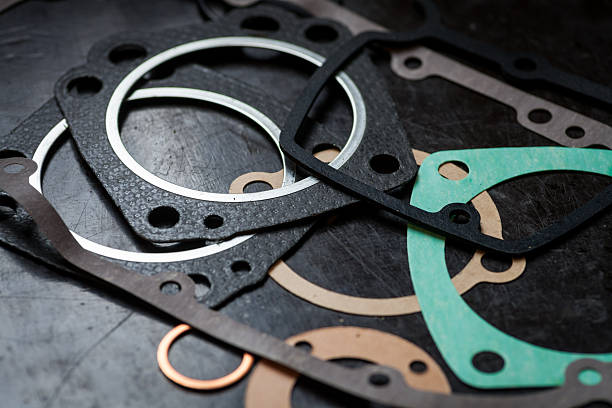
Colvin-Friedman manufactures custom foam gaskets that seal, compress, and protect assemblies across multiple industries. Every gasket is precision die-cut to your specifications with controlled tolerances that hold from prototyperuns through high-volume production.
Based in Petaluma, California, we’ve cut foam gaskets for over 70 years and have zero recorded quality rejections.
or call Vice President Josh Rodman at (707) 769-4488
The following applications illustrate where custom foam gaskets deliver measurable functional value:
| Application | Functional Requirement + Colvin-Friedman Solution |
|---|---|
| Electronics Enclosures | Block moisture ingress or provide EMI shielding at mechanical seams. We match gasket design to required compression behavior and conductivity. |
| EV Battery Modules | Manage compression and thermal interface between module layers. We convert thermal pads, compressible foams, and layered constructions with embedded adhesive. |
| Lighting Housings | Maintain the seal under outdoor exposure and thermal cycling. We convert closed-cell materials that resist moisture intrusion and hold profile over time. |
| Medical Device Housings | Create controlled seals or compliant spacers within diagnostic equipment. We convert medical-grade foams with stable adhesive backing. |
| Industrial Control Panels | Provide sealing at interface points. We cut to spec around irregular geometries and supply adhesive-backed gaskets for fast installation. |
| Aerospace Interiors | Absorb vibration and control compression set under load. Lightweight gaskets are cut to consistent thicknesses for manual or automated installation. |
These foam materials are commonly used in custom gasket applications, with defined cutting constraints.
| Foam Type | Where It's Used | Cutting Constraints |
|---|---|---|
| Neoprene Foam | Compression seals for outdoor enclosures; general-purpose gasketing resistant to oil | Susceptible to shape loss under pressure; blade geometry adjusted for material hardness |
| EPDM Foam | Environmental seals in assemblies exposed to UV and temperature extremes | Can deform under cutting pressure; blade settings calibrated to preserve shape |
| Polyethylene Foam (Closed-Cell) | Moisture-resistant gaskets in lighting and electronics | May rebound after cutting if not stabilized; test cuts characterize recovery behavior |
| Polyurethane Foam (Open-Cell) | Low-pressure gasketing in thin-format builds | Thick sections collapse under press pressure; edge definition requires support |
| Silicone Foam | Temperature and chemical-resistant seals for aerospace and medical applications | Flexible material requires controlled blade depth to prevent incomplete cuts |
| EVA Foam | Shock absorption in sports equipment and protective packaging | Requires sharp dies to maintain clean edges; valued for UV resistance |
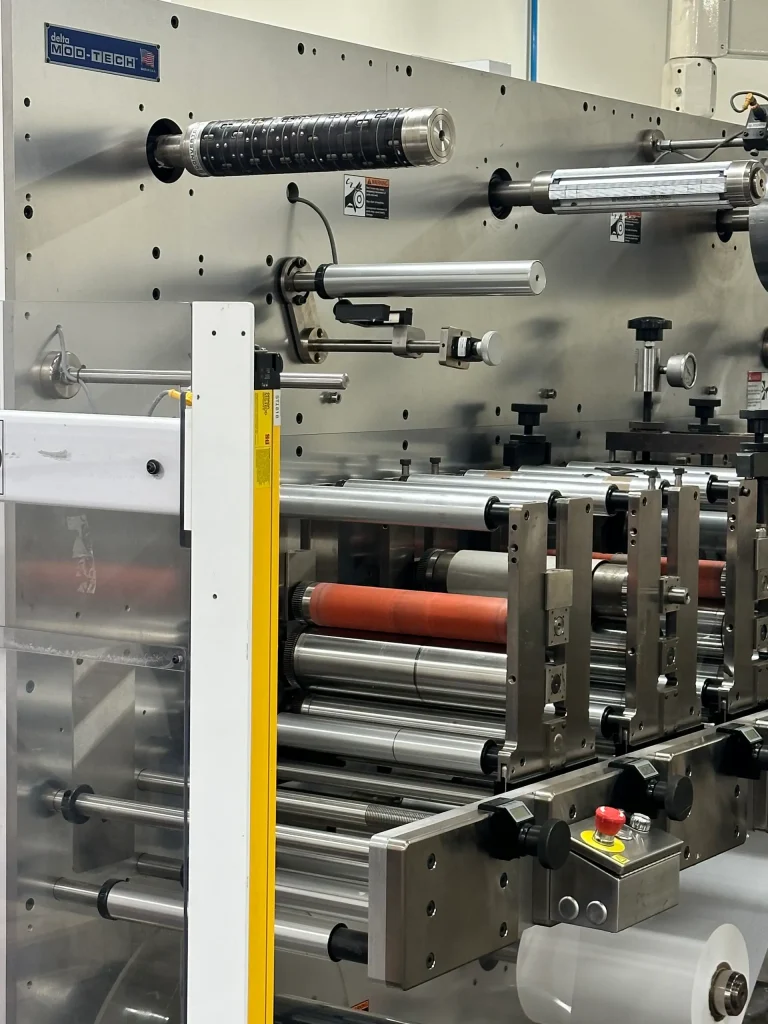
Colvin-Friedman supports engineers by addressing the practical realities of foam conversion:
01
We gather sealing requirements, compression targets, and installation methods. Material and adhesive recommendations are confirmed

02
CAD specialists create die layouts optimized for material yield. Dies are custom-tooled using high-grade steel, with blade geometry matched to foam type.

03
Sample parts are inspected for dimensional accuracy and adhesive performance. Test cuts verify compression behavior. Clients receive samples for fit testing.
04
Tooling is calibrated for each material. Kiss-cut depth is held within ±0.001″ where required. Parts are spot-checked during production for edge quality and profile accuracy.
05
We integrate into your production schedule with blanket orders and scheduled releases. Our 99.99% on-time delivery rate eliminates the need for emergency orders.
We offer multiple cutting methods to meet different dimensional and production requirements:
| Capability | Rotary Die Cutting | Flatbed Die Cutting |
|---|---|---|
| Maximum Width | 16 inches | 40 inches |
| Maximum Thickness | 0.015 inches (varies by material) | 0.5 inches (material dependent) |
| Tolerance Level | ±0.005 inches | ±0.010 inches |
| Production Capacity | Up to 40,000 units/hour | 2,000-4,000 parts/hour |
| Average Lead Time | 3 weeks | 3 weeks |
Colvin-Friedman delivers precision foam gaskets with predictable lead times and zero-defect quality. Contact Vice President Josh Rodman directly at (707) 769-4488 or upload your file to start your quote.
We convert neoprene, EPDM, polyethylene, polyurethane, silicone, and EVA. We also handle
specialty foams, including medical-grade formulations. Send us the material spec, and we’ll confirm manufacturability.
Yes. We laminate acrylic and silicone pressure-sensitive adhesives to foam substrates before cutting. Adhesive selection depends on your surface material and exposure to temperature. We can supply kiss-cut parts on liner or adhesive-backed gaskets sheeted for hand assembly.
Standard tolerances range from ±0.010″ to ±0.020″ depending on foam type. Thinner materials cut with rotary dies can hold ±0.005″ on critical dimensions.
Yes. We cut prototype quantities to verify fit and material performance before committing to production tooling. Prototypes allow you to test compression behavior and installation method before scaling.
Yes. We integrate into your production schedule with blanket orders. Our supply chain integration ensures you maintain inventory without carrying excess stock.