

Or Call Josh (707) 769-4488
Felt die-cutting supports multiple engineering applications, particularly in sealing, dampening, lubrication, and acoustic control.
| Application Category | Specific Components | Key Requirements |
|---|---|---|
| Sealing Systems |
|
|
| Vibration Management |
|
|
| Lubrication Systems |
|
|
| Noise Reduction |
|
|
Our team evaluates fiber composition, density, and thickness against your application’s pressure, temperature, and chemical exposure requirements before recommending a specific felt grade.
Felt’s nonwoven structure delivers performance characteristics that woven textiles and solid elastomers cannot match. The material compresses without permanent deformation, absorbs vibrations through its fibrous matrix, and wicks lubricants evenly across contact surfaces.
Material Behavior at the Die Line
Natural wool felt can absorb up to 33% of its weight in moisture while maintaining dimensional integrity. Synthetic polyester and acrylic felts offer superior chemical and solvent resistance and higher temperature thresholds, up to 250°F compared to wool’s 200°F limit. Both materials require specific tooling configurations to prevent fiber pull and edge fraying during cutting.
Or Call Josh (707) 769-4488
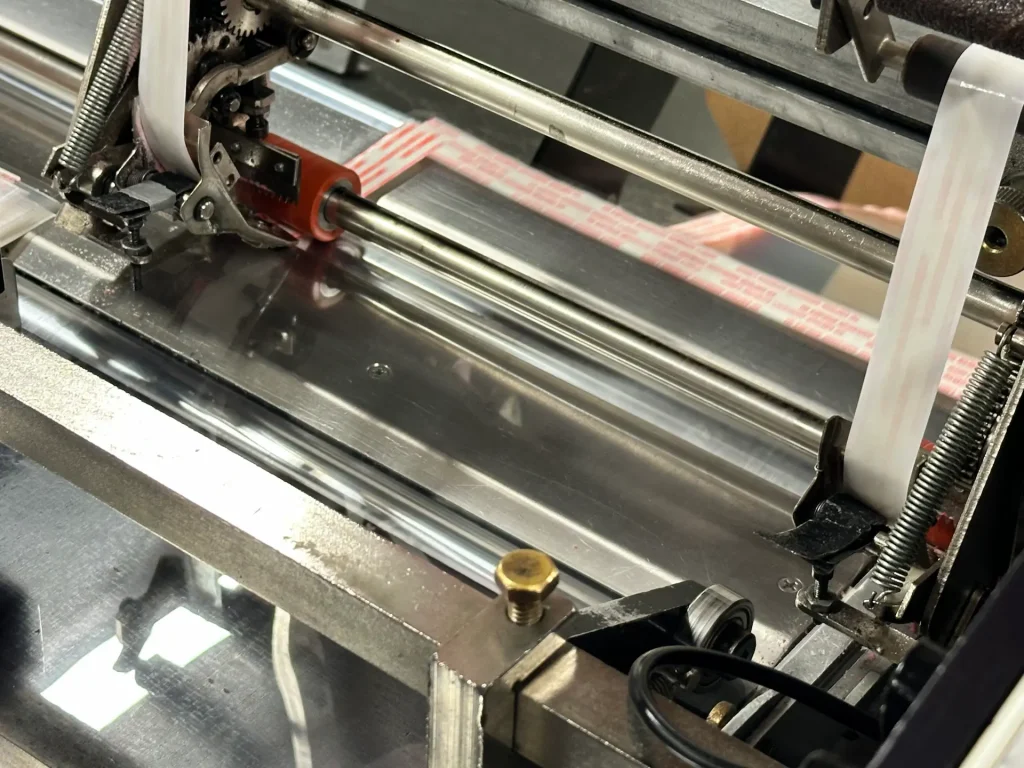
We process natural wool, synthetic polyester, acrylic blends, and mixed-composition industrial felts across both rotary and flatbed platforms.
| Specification | Rotary Die-Cutting | Flatbed Die-Cutting |
|---|---|---|
| Maximum Width | 16 inches (we slit larger jumbos) | 40 inches |
| Thickness Range | Up to 0.015 inches | Up to 0.5 inches |
| Tolerance Level | ±0.005 inches | ±0.010 inches (material-dependent) |
| Production Capacity | Up to 40,000 units/hour (size-dependent) | 2,000–4,000 parts/hour (size-dependent) |
| Average Lead Time | 3 weeks | 3 weeks |
When to Choose Rotary vs. Flatbed
Rotary die-cutting suits high-volume production of thinner felts where tight tolerances and rapid throughput are critical. Flatbed processing handles thicker substrates, larger part dimensions, and geometries requiring high-tonnage presses.
We've been cutting fibrous materials since 1949, starting with thermal insulators for radio and television manufacturers. That foundation taught us how to manage fiber orientation, prevent edge delamination, and control thickness variation across large production runs.
Felt behaves differently from films or foams. Compression set, fiber density gradients, and moisture content all affect cut quality. We prototype using production-intent materials and tooling to identify issues before you commit to full production runs. This approach has reduced tooling iterations by up to 50% for clients transitioning from other die-cutters.
We hold raw felt materials on-site and integrate directly with Kanban, JIT, and Min/Max inventory systems. Our 99.99% stock-out avoidance rate means your production lines maintain continuity while you reduce carrying costs.
Material selection depends on your application’s mechanical stresses, environmental conditions, and regulatory requirements. We provide recommendations based on pressure ratings, chemical exposure, temperature extremes, and end-use durability needs.
From initial material selection to final production, our felt die-cutting process is designed to deliver reliable and repeatable results.
01
Evaluate component function (sealing, vibration dampening, lubrication wicking) and select appropriate felt properties such as density, fiber composition, thickness, and flame resistance.

02
Review drawings for potential production issues (e.g., tight radii or thin holes that may distort fibers). Produce prototypes using the specified felt grade and tooling to validate dimensions and edge quality.

03
| Industry | Typical Applications |
|---|---|
| Automotive |
|
| Industrial Machinery |
|
| HVAC Systems |
|
| Electrical Equipment |
|
Felt die-cutting from Colvin Friedman is the best solution for OEMs and manufacturers who require dimensionally consistent sealing, vibration control, or lubrication components across production runs measured in thousands to millions of units. If your application demands specific felt properties, moisture wicking, compression recovery, flame resistance, combined with tight tolerances and reliable delivery, our 75 years of fiber processing experience ensures your components perform as specified.
Or call Josh directly 707-769-4488
Yes. We laminate PSA onto felt substrates and kiss-cut the material to create peel-and-stick components. This eliminates the need for manual adhesive application during assembly.
Flatbed processes typically achieve ±0.010 inches on felts up to 0.5 inches thick. Tighter tolerances depend on felt density, fiber composition, and part geometry.
We maintain an inventory of common felt grades and can source specialty materials to your specifications. Our stocking agreements support automatic reordering to prevent production delays.
Yes. We process pressed wool industrial felts that comply with the FMVSS-302 fire-resistance requirements for automotive applications.
We evaluate projects individually. While we specialize in high-volume production, we support smaller manufacturers when the technical fit aligns with our capabilities.