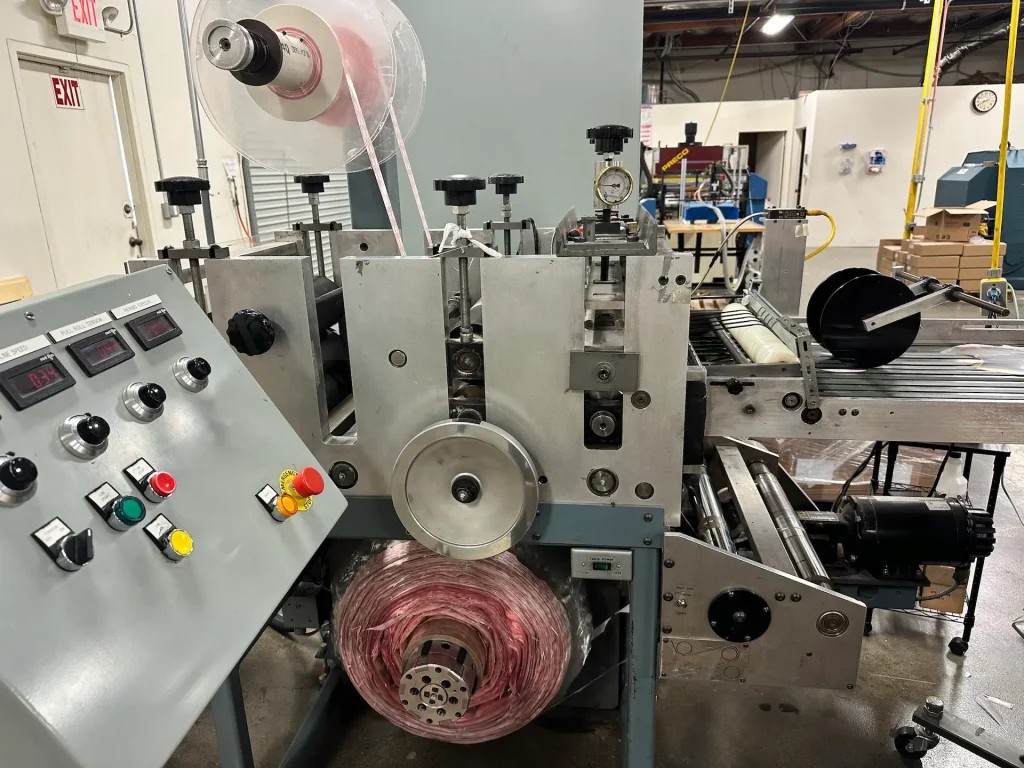

When your products require exact widths and dependable quality, you need a slitting partner who understands what’s at stake. At Colvin-Friedman, we prioritize your manufacturing goals, delivering the precision and reliability that ensure your production runs smoothly. For over 70 years, manufacturers and product designers in medical devices, electronics, automotive, and industrial sectors have trusted us for U.S.-based slitting expertise that reduces risk and supports even the most challenging applications.
Your materials deserve a slitting that’s tailored to their exact requirements. Our advanced equipment and tension control systems are designed to protect dimensional stability and deliver the precision your applications demand. Whether you’re working with delicate substrates or high-volume runs, we optimize slitting for each material to ensure accuracy and reliable performance.
| Capability | Rotary Die Cutting | Flatbed Die Cutting |
|---|---|---|
| Maximum Web Width | 16 inches (can slit down larger jumbos) | 40 inches |
| Material Thickness Range | 0.0005" to 0.015" (flexible with materials) | Up to 0.5" (material dependent) |
| Tolerance Achievement | ±0.005 inches | ±0.010 inches (material dependent) |
| Production Capacity | Up to 40,000 units/hour | 2,000 - 4,000 parts/hour |
| Average Lead Time | 3 weeks | 3 weeks |
Achieving clean, burr-free edges without delamination or material distortion requires more than sharp tooling. We pair precision-ground tooling with material-specific blade geometries and coatings. Tool wear is continuously monitored, and adjustments are made based on live observations rather than waiting for quality degradation.
We ensure tight dimensional tolerances from the start by pre-conditioning materials and monitoring quality throughout production. In-process inspections and skilled operators catch any variance early, protecting part quality and keeping your runs on spec.
| Challenge | Impact | Colvin-Friedman Solution |
|---|---|---|
| Edge Quality Control | Burr formation, delamination, and material distortion | Precision-ground tooling with material-specific blade geometries |
| Width Consistency | Dimensional drift, tolerance failure | Material pre-conditioning and in-process inspection checkpoints |
| Roll Rewinding Precision | Telescoping, wrinkles, tension variations | Automated tension control systems with material-specific parameters |
| Contamination Prevention | Material contamination in sensitive applications | Controlled environment processing with specialized handling procedures |
Automated tension control systems adjust for material properties and thickness variations, ensuring consistent roll quality and preventing contamination in clean-room sensitive applications. We understand how different substrates behave during conversion and implement contamination control measures specific to each application.
Material selection involves understanding how substrates behave during the slitting process, not just reviewing spec sheets. Our technical team works with clients during the design phase to ensure material and process pairings are optimized for both quality and efficiency.
| Material Category | Specific Materials | Key Properties | Applications |
|---|---|---|---|
| High-Performance Films | Polyimide (Kapton®), PET, PEN | Temperature resistance, dimensional stability | Electronics, aerospace components |
| Commodity Films | HDPE, LDPE, PP, PVC | Chemical resistance, flexibility | Industrial, packaging applications |
| Pressure-Sensitive Materials | Medical adhesives, electrical tapes, VHB | Controlled adhesion, biocompatibility | Medical devices, electronics assembly |
| Composite Laminates | Multi-layer systems, foil laminates | Barrier properties, conductivity | Automotive, energy applications |
Not all materials behave the same under slitting forces, and the wrong material selection can introduce tolerance challenges, tool wear, or adhesion problems downstream.
Key Factors We Consider:
Our clean processing environment and expertise in biocompatible materials ensure your components meet the strictest regulatory standards:
| Product Type | Materials | Critical Requirements | Colvin-Friedman Advantage |
|---|---|---|---|
| Electrode Pads | Conductive adhesives, hydrogel | Biocompatibility, conductivity | Medical-grade material expertise |
| Surgical Drapes | Nonwoven fabrics, films | Sterile processing, tear resistance | Contamination-free environment |
| Diagnostic Substrates | Specialty films, membranes | Precise dimensions, optical clarity | ±0.003" tolerance capability |
| Wound Care Products | Medical adhesives, foams | Controlled adhesion, breathability | Adhesive behavior assessment |
Your power electronics perform better when they stay calm and reliable. With high-performance materials such as Kapton® and PET, you get the heat resistance and dimensional accuracy needed to keep your systems running at their best, even on complex, multi-cavity builds:
| Component Type | Materials | Performance Requirements | Processing Capability |
|---|---|---|---|
| EMI/RFI Shielding | Conductive films, foils | Electrical conductivity, conformability | Metal-laminated material expertise |
| Thermal Interface | Thermal pads, phase change materials | Heat transfer, thickness control | Precision thickness management |
| Circuit Substrates | Polyimide, FR-4 laminates | Dimensional accuracy, edge quality | Burr-free cutting technology |
| Battery Components | Separator films, current collectors | Ionic conductivity, purity | Clean-room processing capability |
We cut automotive-grade materials from gaskets and seals to vibration dampeners, enhancing the efficiency and quality of automotive systems. Our capabilities extend to automotive-grade plastics for interior trims, engine bay insulation, and dashboard components that require precise fitment.
| Material Category | Thickness Range | Width Tolerance | Edge Quality | Max Production Rate |
|---|---|---|---|---|
| Thin Films | 0.0005" - 0.005" | ±0.003" | <0.001" roughness | 2,000 ft/min |
| Standard Gauge | 0.005" - 0.015" | ±0.005" | Burr-free | 40,000 units/hr |
| Thick Materials | 0.015" - 0.5" | ±0.010" | Custom tooling | 4,000 parts/hr |
Thin Film Capabilities (0.0005″ – 0.005″) deliver exceptional precision for optical applications and sensitive electronics, with tension-controlled rewinding to prevent distortion.
Standard Gauge Materials (0.005″ – 0.015″) represent our highest volume processing capability, optimized for consistent edge quality and dimensional accuracy across extended production runs.
Specialty Thick Materials (up to 0.5″) utilize our flatbed processing capability with custom tooling designed for specialized substrates requiring precise dimensional control.
Each slitting job incorporates inspection checkpoints tied to critical dimensions rather than general pass/fail criteria. Both rotary and flatbed lines feature real-time verification systems, ensuring precision is maintained throughout production runs.
Our approach includes:
Our commitment to precision converting has resulted in zero recorded quality rejections, demonstrating our ability to meet the most demanding tolerance requirements consistently.
| Quality Metric | Monitoring Method | Control Limits | Corrective Action |
|---|---|---|---|
| Dimensional Accuracy | In-process measurement | ±0.005" (rotary), ±0.010" (flatbed) | Real-time adjustment |
| Edge Quality | Visual and tactile inspection | <0.001" edge roughness | Tool adjustment/replacement |
| Roll Quality | Tension monitoring | Consistent winding profile | Automated tension control |
| Material Integrity | Continuous web inspection | Zero defects standard | Process parameter optimization |
Our 3-week average lead time with expedited processing available eliminates the 8-12 week delays common with overseas alternatives.
Direct Communication Benefits:
| Quality Metric | Monitoring Method | Control Limits | Corrective Action |
|---|---|---|---|
| Dimensional Accuracy | In-process measurement | ±0.005" (rotary), ±0.010" (flatbed) | Real-time adjustment |
| Edge Quality | Visual and tactile inspection | <0.001" edge roughness | Tool adjustment/replacement |
| Roll Quality | Tension monitoring | Consistent winding profile | Automated tension control |
| Material Integrity | Continuous web inspection | Zero defects standard | Process parameter optimization |
From prototype quantities for product development to high-volume production runs, our flexible manufacturing approach accommodates your exact requirements without forcing you into inappropriate order sizes.
Prototype Support: Low-volume development runs with engineering feedback
Scale-Up Capability: Seamless transition to production volumes
High-Volume Production: Capacity for millions of units annually
Our technical consultation begins with understanding how your specific substrate will behave during the slitting process. We work with clients early in the design phase to optimize material and process pairings for both quality and efficiency.
| Service | Deliverable | Timeline | Benefit |
|---|---|---|---|
| Material Assessment | Substrate behavior analysis | 1-2 days | Optimal process selection |
| Tolerance Verification | Capability confirmation | 2-3 days | Risk mitigation |
| Test Cutting | Sample parts production | 3-5 days | Process validation |
| Tooling Design | Custom die specification | 5-10 days | Production optimization |
Whether you need short prototype runs or high-volume production, Colvin-Friedman’s precision slitting services deliver the accuracy and reliability your applications require. With 70+ years of converting expertise, advanced equipment, and a U.S.-based facility, we’re the trusted partner for even the most demanding projects.
Specializing in thin-gauge films, flexible substrates, and precision converting since 1949