
Flatbed and rotary die cutting both convert raw material into finished parts, but they use different mechanics, and each one suits a different combination of volume, material, and tolerance. This guide compares both processes across five factors so you can match the process to your project.
In this guide, you’ll learn:
How Flatbed and Rotary Die Cutting Work
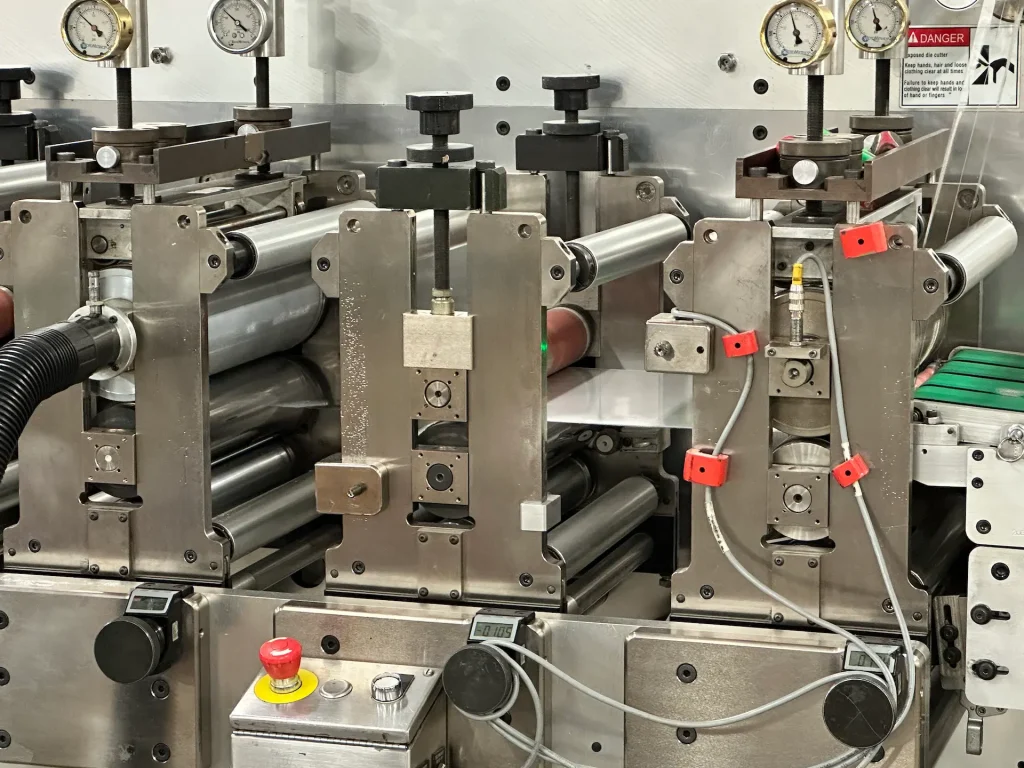
A flatbed press holds a flat steel rule or a matched metal die above its bed. The press strokes straight down through the material, then lifts, indexes the material forward, and strokes again. A rotary press mounts the die on a rotating cylinder or magnetic sleeve. The cylinder turns continuously against an anvil roller while material feeds through as a continuous roll, so the cut never stops to index.
| Factor | Flatbed | Rotary |
|---|---|---|
| Cutting motion | Vertical stroke; stops between cuts | Continuous rotation; no stop |
| Material format | Sheets or indexed material | Continuous roll (web) |
| Die changeover | Swap the flat die on the bed | Swap the cylinder or magnetic sleeve |
The Repeat Length Constraint on Rotary Tooling
A rotary die’s cylinder circumference sets a fixed repeat length, the distance from one cut to the next. Every part cut on that cylinder must fit within the repeat, so changing part length usually requires a new cylinder. A flatbed press carries no such constraint, since the bed indexes forward by whatever distance the design requires. Flatbed tooling adapts to a part-length change without new hardware in most cases, which is one reason engineering teams often prototype on flatbed equipment before committing a stable design to rotary tooling.
Production Volume and Speed
Rotary die cutting runs continuously, so it produces parts faster and suits long, steady production runs. Flatbed die cutting stops and indexes between cuts, so it runs slower and suits shorter runs or designs that change often.
| Factor | Flatbed | Rotary |
|---|---|---|
| Best order size | Short to moderate runs | Long, high-volume runs |
| Relative speed | Moderate | High |
| Mid-run design changes | Fast and inexpensive | Slower and costlier |
Multi-Station Processing
Rotary die-cutting equipment often combines several operations into a single pass. A single rotary line can cut, score, remove waste, and laminate material together, so a finished part can leave the press without moving to a separate station. Flatbed die cutting typically performs one operation per stroke, so parts that also require lamination or scoring must go through additional steps after cutting. This difference compounds at high volume, since each additional station a part visits adds handling time and increases the risk of error across thousands of parts.
Tooling Cost and Lead Time
Flatbed dies cost less to build and ship faster because the tooling is simpler to machine. Rotary dies cost more upfront and take longer to produce because the manufacturer cuts the pattern into a cylinder or magnetic sleeve. Rotary tooling pays off as volume climbs, since the cost spreads across more parts. Flatbed tooling pays off when a design changes often or the run stays small.
| Factor | Flatbed | Rotary |
|---|---|---|
| Tooling cost | Lower | Higher |
| Typical lead time | 1 to 3 business days | 5 to 10 business days |
| Cost per part at high volume | Higher | Lower |
Material Compatibility
Flatbed die cutting handles thicker, denser, and multi-layer materials well, including foam, cardstock, heavy liners, rubber, and sheet plastic thicker than about 1/8 inch. Rotary die cutting favors thin, flexible materials that move well as a continuous web, including films, foils, laminates, pressure-sensitive tapes, and release liners.
| Material Type | Better Fit |
|---|---|
| Foam, heavy liner, rubber, thick sheet plastic | Flatbed |
| Thin film, foil, laminate, pressure-sensitive tape | Rotary |
| Paper and cardstock | Either, depending on thickness and run length |
Kiss Cutting and Additional Material Notes
Rotary die cutting also supports kiss cutting, a technique that cuts through the top layer of a laminated material while leaving the liner underneath intact. This makes rotary the standard choice for labels, stickers, and other adhesive products that need to stay mounted on a liner until the customer peels them off. Flatbed die cutting also supports thin-gauge metals, in addition to the foams, plastics, and cardstock covered above, when a job calls for a rigid or specialty substrate that a rotary cylinder cannot flex around.
Tolerance and Quality Control
Rotary die cutting typically holds tighter tolerances than flatbed die cutting because continuous rotation keeps pressure and part spacing consistent. Flatbed die cutting still meets most tolerance requirements, but it leaves less margin on parts with tight fit-up needs.
Each process carries its own quality risk. Rotary equipment can drift dimensionally when web tension shifts rapidly. Flatbed equipment can deform a part’s edge when heavy downward pressure is applied to thick or dense material, and the die needs maintenance.
| Factor | Flatbed | Rotary |
|---|---|---|
| Typical tolerance | ±0.010 in | ±0.005 in or tighter |
| Main quality risk | Edge deformation on thick materials | Dimensional drift from web tension |
Managing Web Tension on Rotary Equipment
Shops that run rotary die cutting typically manage web-tension risk with closed-loop tension control, automatic web guides, and regular roller and alignment checks. These controls keep the material tracking straight through the cylinder and reduce the wrinkles, skewed cuts, and dimensional drift that inconsistent tension can otherwise cause across a long run.
Flatbed die cutting sidesteps web tension entirely because the material remains flat and still during each stroke. Its equivalent maintenance task is keeping the steel rule sharp, since a dulled blade is the more common source of a ragged edge on flatbed equipment.
Match the process to the project rather than picking one process for every job. A short run of thick foam gaskets favors flatbed die cutting. A long run of thin adhesive film favors rotary die cutting. Many projects start on flatbed tooling for prototyping, then move to rotary tooling once the design stabilizes and volume increases.
Weighing flatbed against rotary? Share your specs and volume with our team to find the right process before committing to tooling.